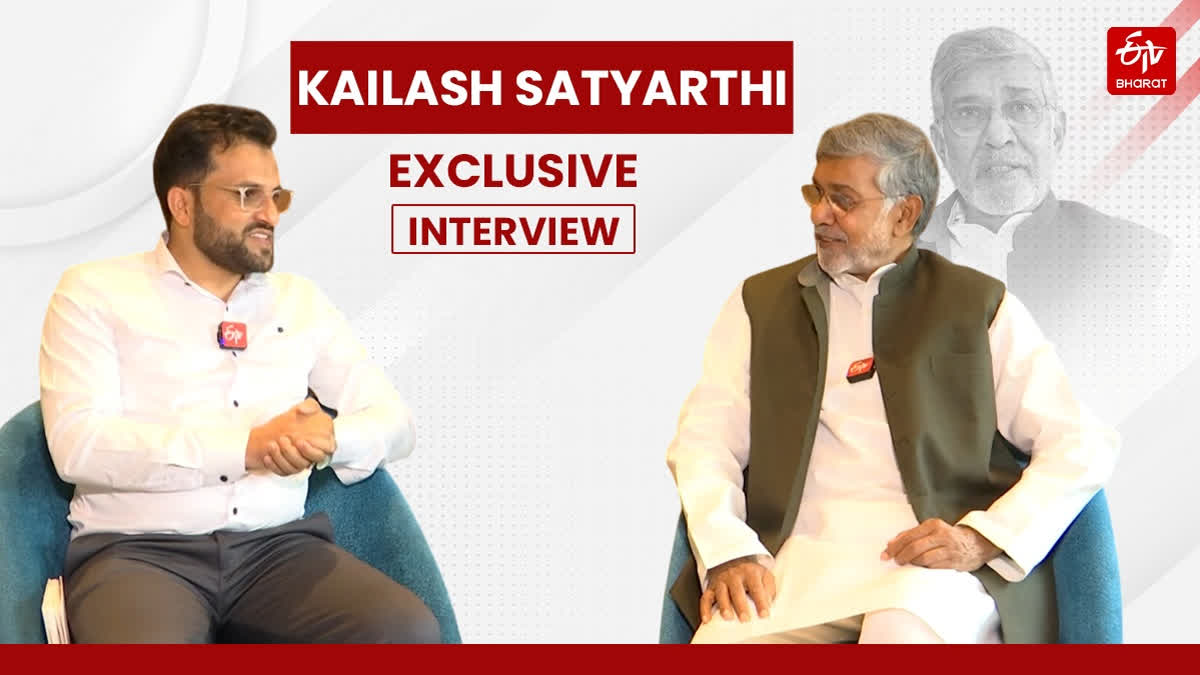
Interview | From Trump’s Nobel Demand To CQ In Karuna: Kailash Satyarthi’s Blueprint For Making World A Better Place For Children
Hyderabad: In a world living through a complex multi-polar order, a world where economic dependencies are being weaponised to bully and silence the weak, is there a single solution to the more crucial but largely sidelined issues of poverty, human suffering, climate change, and most importantly, the overall safety and well-being of our children?
Who better to answer this question than Kailash Satyarthi, the Nobel laureate and one of the loudest global voices for the oppressed and the voiceless.
In an exclusive interview with ETV Bharat’s Nisar Dharma on Friday, Satyarthi spoke about how he has attempted to give compassion a new definition in his latest book, ‘Karuna: The Power of Compassion,’ released earlier this month.
Excerpts from the interview
Nisar Dharma: You talk about the Compassion Quotient or CQ in your latest book Karuna: The Power of Compassion. How is it different from IQ and EQ we grew up learning about?
Kailash Satyarthi: I realised that compassion is the solution to all the complex problems the world is facing right now. The definition of my compassion is different. It is not kindness, mercy or pity. It is not even sympathy or empathy. People put all these phrases in one basket. But I have redefined and reinvigorated the power of compassion. Compassion is not a soft emotion, or a value or virtue. Compassion is a force born from feeling the suffering of others as one’s own suffering.
That force drives a person to take mindful action. In simplest terms, compassion is mindful problem-solving. When I talk about Compassion Quotient (CQ), we need to understand that all of us are born with the innate power of compassion. Consciousness and compassion are the two divine gifts. But we keep on losing track of compassion because of several factors, including our upbringing, our education system, the socio-cultural and political environment. We have lost the power of compassion as a transformative force.
IQ and EQ are very individualistic, but CQ is not. CQ is determined by four components, all of which are measurable. The first one is awareness, the second is connectedness, the third is feeling and the fourth is action. When you achieve the first three components, they lead to a force, an action which becomes the problem solver.
Compassion is force, compassion is action, compassion is problem-solving. Compassion has enormous power to question the wrongs and the injustices around us. And compassion also helps in finding answers. So CQ is something very new. But I am confident this is going to be a game-changer. CQ can apply to all aspects of our lives. Be it a personal decision of choosing a partner, or be it the corporate world and the decision to employ someone. CQ would be the defining factor in the future.
Nisar Dharma: How is Karuna: The Power of Compassion different from Diyasalai, your autobiography that was published last year?
Kailash Satyarthi: Diyasalai documented my whole life, including my struggles, failures and successes, and everything that I could accomplish by the power of compassion. I started realising that it is not just me, there are thousands of people who brought transformation in the society, fought for justice, equality, peace and sustainability. Their driving force has also been compassion. I am convinced that all the religions in the world originated from that spark of compassion. All religious leaders of the world felt the suffering of the masses as their own problems; they did not sit quietly. They were not overwhelmed. They did not give up. What they did was take conscious decisions to fight for alleviating the sufferings of others.
Similarly, all revolutions and social transformations were born out of the spark of compassion. I thought that what the world needed today was compassion. And that was one of the reasons that I penned down some of my thoughts based on my experience and the experiences of other people.
Compassion is a transformative, dynamic and disruptive force. No other way can we solve the deep-rooted problems of injustice. Be it gender or racial discrimination, the hatred and violence that is growing and systematically spreading globally. We have to follow this new idea of compassion as force, as action. This book defines this idea. I also feel that there is a need for self-compassion. Especially in a world where 1 out of 6 people are stressed, suffering from depression or similar challenges. Self-compassion can go a long way in helping us find our inner best friend.
Nisar Dharma: We see in today’s world how powerful nations are trying to bully the smaller ones, setting not-so-great examples for our younger ones. Do you think growing up in such a world would impact the children’s understanding of compassion?
Kailash Satyarthi: There are good leaders. Good leaders in faith institutions, in politics, and in all walks of life. Very few, but they are definitely there. But their voices are not so loud. As they say, evil runs very fast and speaks the loudest. On the other hand, goodness and virtues may be slow and silent. We have to find such leaders.
You are right when you talk about the younger generation being impacted. Is it not shameful that globally, 473 million, more than 47 crore, children are living in war-prone areas or areas impacted by conflict. They are not responsible for any war, yet they are the worst sufferers. What is the fault of the children being killed in Gaza? Sometimes they die from hunger. Food is there, but the food trucks are stopped. They are injured, they fall sick, but medicines don’t reach them. What is their fault?
Children must not pay the price for what the adults do. Adults must choose compassionate diplomacy and dialogue. More than 13 crore children are languishing in child labour and modern-day slavery. Some of them are sold and bought like animals, at prices even lower than what one pays to buy an animal. Whose fault is this? This is our fault. Whose children are these? They are our children. They are your children, they are mine.
Unless a sense of compassion and moral responsibility arises, I am sorry to say, but no scheme, no law, no sermons can protect these children and their childhood. That is why we have to globalise compassion. If India and Indians, with such great history, cannot take the lead in globalising compassion, who else can?
Nisar Dharma: Can you throw some light on Satyarthi Movement for Global Compassion (SMGC)?
Kailash Satyarthi: This new movement, the Satyarthi Movement for Global Compassion, is rooted in my previous works and what I have learnt over the years. I have come to realise that we have to have a sustainable, solution-oriented approach. And children’s issues cannot be solved in isolation.
When the world is burning, when people are ready to fight with each other without any reason, and the children have to pay the cost, it is necessary that we have to look for a broader solution. And I found that it is possible through launching a worldwide movement for compassion.
So SMGC has been widely supported in the last one and a half years. It has received immense support from several Nobel laureates, from Peace as well as other disciplines, world leaders, and former heads of state.
People have resonated with it (SMGC), even young people. I always say that youth are filled with both passion and compassion, which can be used to make the world a better place. Wherever I spoke, in universities and colleges, about my definition of compassion as selfless, mindful problem solving, they liked it. It is not a religious concept. Compassion is secular. Religious leaders and faith institutions perhaps think that they are preaching compassion and that is enough. Their efforts remain hollow if they don’t live the compassion they preach. With utmost humility, I would say that everybody has the power of compassion; we just need to remove the layers that we have covered it with.
Nisar Dharma: I recently spoke to Sunitha Krishnan. She said technology has made tracking human traffickers more difficult, and that it was fast becoming a faceless crime. How do you see the problem of human-trafficking in India?
Kailash Satyarthi: I have great respect for my younger sister, Sunitha Krishnan ji. She is one of the bravest fighters against human slavery and trafficking. I agree with her. Trafficking is an organised crime and involves many forces. Human trafficking is one of the most lucrative illicit trades in the world. The issue is cross-border now. Technology has made trafficking easier, comfortable and at the same time invisible. The invisible hands are snatching young girls and boys from their parents.
A lot of work needs to be done in India for the prevention, prosecution, and conviction of human traffickers. Technology must prove to be the saviour for such children and women who are the victims of human slavery and trafficking. Technology could be a powerful tool if it is in the hands of those who believe in freedom, dignity and justice for everyone, especially children and other vulnerable sections of society.
Nisar Dharma: The US President has repeatedly demanded that he should be given the Nobel Peace prize for all the wars he has “stopped”. How do you look at it?
Kailash Satyarthi: It is a funny situation. Let me tell you that in the last few weeks, many people started knowing me and respecting me after they learned that an Indian is a Nobel Peace laureate. People understood the value of the Nobel Peace prize, that it is bigger than being the President of the US.
Everybody can do good work and get the prize, but it should not be the end goal. When I received it, people told me I had become a celebrity, the first Indian born Indian to get the Peace prize. I told them that it was just a comma in my life. That it was not going to make me an exclusive person or a khaas aadmi. I continue to work and fight for my cause. I would wish President Trump gets the Nobel Prize, but it requires another approach, another mindset. I wish him all success in his life.
Nisar Dharma: Could you revisit the incident when you saved Devli, a third-generation slave in a stone quarry, and several others in 2004?
Kailash Satyarthi: She spoke those words in a Rajasthani dialect. ‘Tu pehle kyun nahi aayo’: those were her words. When she said that, I felt that as humans, we had failed. Even if one child is in danger, how can we call ourselves civilised? Even if one girl is left in slavery, how can we say that the world is free? How can we talk about democracy? I had learnt then that some families were kept in bonded labour at an illegal stone quarry in Haryana. The quarry belonged to a very powerful, political family. One of the family members was a parliamentarian. When we tried to approach the local authorities, no government official agreed to go to the spot. They completely denied that there were any bonded labourers at the quarry. So we planned at our level, did some recce, and decided that we would rescue the families early in the morning.
We learned that there were children who were born in the stone quarry, their parents had been married there, and their grandparents had been enslaved and trafficked from Rajasthan to Haryana. Three generations. It was very risky and dangerous. But I love such operations. So my friends and I decided to go early in the morning, knowing the gunman guarding the quarry would not be there in the early hours. He used to go to the nearby village in the mornings to freshen up. We went there and were able to rescue more than 50 children, women and men. We had brought a truck and my car. So I took the younger children, 6, 7, and 8 years old, in my car. I drove fast since I had to get away from the area or else word would go out, and we might get killed. All these children were traumatised. I had some bananas lying in the back of my car, so I asked the children in the back to eat the bananas.
The child in the back touched the bunch of bananas, but did not know what to do with them. He then passed the bunch to other children who started mumbling ‘what kind of potato was it?’ They had never seen a banana. When I told them to have it, some of them tried to eat the banana with the peel, spitting it out immediately. I felt stupid not to show them how it had to be eaten. Some of them ate, others did not. They have never tasted anything sweet. Then suddenly, I felt a heavy hand on my shoulder. It was heavy since it was the hand of an 8-year-old child (Devli) who was tasked to break stones with a hammer every day.
When I looked at her, I could see that so many emotions appeared on her face at once. A sense of belongingness, anger, deep sorrow, and expectations. She asked, ‘Kyun re. Tu pehle kyun nahi aayo’. The child had seen her father burnt with bidis because he tried to stop the rape of his wife. She had also seen how her younger brother died in her lap because there was no medication. When she told me why I didn’t come sooner, I started crying. It was not a question, it was a challenge to everyone who believes in laws, constitution. It was a challenge to anyone who believes in any holy man, holy book, or any religion. It was a challenge to humanity. Why didn’t you come sooner? What stopped you?
Nisar Dharma: What advice would you give to young activists and changemakers looking to make a difference?
Kailash Satyarthi: Just be grateful. You can begin with your parents, siblings, neighbours, those who help you, the labourers, electricians, plumbers, craftsmen, those who produce food so that we can survive, those who stitch our clothes. Let’s begin with developing a sense of gratitude. It would then lead to a sense of moral responsibility and eventually action through compassion. If you start with your surroundings, you will be a more genuine activist than many of those who choose activism as a stepping stone into politics or to grab power. I think every good human being is an activist.
Nisar Dharma: Have you ever thought of joining politics?
Kailash Satyarthi: None of us is free from politics. We are either in active politics or in passive politics. I am in active politics. My politics is not for the next election or for a position or power. My politics is for the next generation and the ones coming after. The purpose of politics is to serve people and ensure they get justice. Unfortunately, it has lost its meaning. Politics now means power hunger. My politics is that we have to work for children, and their children, and then their children, so that when we leave this world, we will leave with a sense that we have made the world a little bit better.
Nisar Dharma: Is Kailash Satyarthi content with whatever he has achieved so far?
Kailash Satyarthi: Not yet. I never wanted to achieve anything for myself. But yes, what I wanted to achieve for others has not been achieved yet. It is an ongoing struggle, an ongoing fight. Some agree, some support, some disagree, and even oppose, but the fight is on. The very first day of my school was an eye-opener for me when I saw a cobbler’s boy, who was my age, sitting right outside our school. I felt disappointed. I asked my teacher and my parents and others about it. They all tried to convince me that it was not uncommon for the children of the poor to help their families. Every day I watched that child working under the open sky, sometimes alone and sometimes with his father. One day, I gathered courage and asked the boy and his father about it. The father stood up, folded his hands and said that he and his father had started working since their childhood, and his son was doing the same. He then said, “Babuji, you guys are born to go to school, but we are born to go to work.” It was a challenging thought that remained with me for the rest of my life. I realised that something was wrong in society. That the divine cannot be this unjust. It is we who have divided ourselves. I felt a sense of urgency to do something and it still continues.