“When writers, artists, scientists, and innovators are guided by compassion, their work can shape awareness and inspire collective responsibility.” Kailash Satyarthi
Never before has our world been so wealthy, well-informed and technologically advanced. Yet we are facing an unprecedented crisis: humanity is plagued by conflict, inequality and indifference. It is imperative, therefore, that we rethink our approach to life and society, and that we do so now. The answer lies in karuna, compassion.
Compassion is not a soft emotion but a powerful force for transformation. It transcends borders, ideologies, religions and politics. And it asks only this: Act mindfully, as if the world is all one family—because it is.
Nobel Peace Prize awardee Kailash Satyarthi has fought for the rights and dignity of millions of marginalized people across the globe for the past five decades. For him, compassion is a way of life. In this new book, he shows us how karuna is the answer to our individual, social and global problems, and the key to a better future.
Team Kitaab: In Karuna – The Power of Compassion, you describe compassion as a transformative force rather than a soft emotion. How did your personal experiences shape this understanding of karuna?
Kailash Satyarthi: In Karuna: The Power of Compassion, I describe compassion not as a soft emotion, but as a transformative force shaped by my life experiences. When I began my work as a rights activist, I saw that the suffering of millions of children was rooted in deep social, political, and economic injustices. Compassion over the years became my source of strength — not pity or kindness, but the courage to act for freedom, justice, and equality.
This understanding began much earlier in my childhood. When I saw classmates dropping out of school because they could not afford books, I used my reward money to collect used books door to door and create a small “Book Bank.” That simple act allowed many children to continue their education.
When I reflect on my journey, I realised early that compassion is mindful problem-solving. It means not sinking into the pain of others, but choosing to take action to relieve it. When one person acts with compassion, others are inspired to join. That is its true power.
Team Kitaab: The book emphasizes acting as if “the world is all one family.” How do you see individuals balancing this universal compassion with the complexities of local or cultural differences?
Kailash Satyarthi: Differences and diversity are natural phenomena. They are, in fact, among humanity’s greatest strengths. Individual freedom, dignity, and diversity of thought and action enrich our collective existence.
At the same time, no one can survive alone. Interdependence and interconnectivity is what forms families, communities, and societies. Our lives are deeply woven into one another.
Balancing compassion with cultural differences requires recognizing both truths simultaneously: respecting diversity while embracing mutual responsibility. When we honour individual identities yet acknowledge our shared humanity and interdependence, we embody the true spirit of “the world is one family.”
Universal compassion does not demand uniformity – it calls for unity with respect.
Interdependence and interconnectivity is what forms families, communities, and societies. Our lives are deeply woven into one another.
Kailash Satyarthi, Author (Karuna – The Power of Compassion)
Team Kitaab: You have spent over five decades advocating for children and marginalized communities. How does the lens of compassion influence policy and grassroots activism differently?
Kailash Satyarthi: Compassion shapes both policy and grassroots activism, but it does so in distinct ways. At the grassroots level, compassion drives immediate action. It makes us notice the struggles of the most marginalized and prompts us to address their suffering directly. It ensures that no child, no family, no community is left behind.

In policy-making, compassion becomes a guiding principle for designing systems that are inclusive, just, and sustainable. It asks us to measure progress not by numbers and statistics, but by whether the last person, the most vulnerable, has access to education, safety, and opportunity. True progress is achieved only when even the last person in the line is empowered and protected.
Through this lens, compassion is both the moral compass and the practical framework. For me, this focus on the last person has always been central to my work.
Team Kitaab: In today’s technologically advanced and hyper-connected world, indifference still persists. What role do you think literature, storytelling, and art play in awakening compassion?
Kailash Satyarthi: In today’s technologically advanced and hyper-connected world, indifference persists not because we lack information, but because there is a disconnect. Disconnect between individuals, countries and societies. Literature, storytelling, and art play a crucial role in awakening compassion by expanding perspectives, deepening awareness, and helping us see “the other” as someone like ourselves.
Stories allow us to step into another person’s life. They build relatability and human connection. When we see the world through someone else’s eyes, distance dissolves, and indifference becomes harder to sustain.
Literature, art, culture, and even technology are reflections of the human mind and heart. If their creators are guided by individualistic, divisive, or purely profit-oriented mindsets, these powerful tools can contribute to fragmentation, and society will reflect that fragmentation.
However, when writers, artists, scientists, and innovators are guided by compassion, their work can shape awareness and inspire collective responsibility. They can help build a more just, equitable, peaceful, and sustainable world.
Read an exclusive excerpt from Karuna by Kailash Satyarthi
Team Kitaab: Karuna suggests that compassion transcends politics, religion, and ideology. Can you share an example from your work where compassion overcame seemingly insurmountable divisions?
Kailash Satyarthi: One of the clearest examples from my work comes from the Shrinathji Temple in Nathdwara, Rajasthan — a place where, for centuries, Dalits were forbidden entry. The temple’s main gate even bore the inscription: “Untouchables are not allowed entry in the temple premises.” This was not just a rule; it was a reflection of entrenched social, religious, and political mindsets, and challenging it seemed almost impossible.
Yet, guided by compassion and a commitment to human dignity, I chose to act. On 2 October 1988, along with a group of Dalit friends, I led a procession from Udaipur to the temple to offer prayers. We were ambushed by priests and temple officials wielding sticks and rods.
My insistence on staying until all my friends were safe was not merely about courage; it was about responsibility, solidarity, and compassion in action. Had I moved prematurely, many could have suffered far worse. This act of compassion and moral courage began to change mindsets. The late President of India, R. Venkataraman, later expressed his desire to visit the temple alongside Dalits, and the Chief Minister of Rajasthan personally went there with a group of Dalits to ensure their inclusion. The stone inscription at the temple gate was permanently removed, ending a centuries-old practice of exclusion.
This experience taught me that compassion is not passive; it is active, courageous, and transformative.
Team Kitaab: How do you address skepticism or resistance from those who view compassion as naive or ineffective in solving real-world crises?
Kailash Satyarthi: I see skepticism as a good starting point. In fact, I appreciate resistance because it opens the door for deeper dialogue. But I often ask: how do we solve age-old systemic discrimination, entrenched injustices, and deep social divisions without compassion?
Consider racial discrimination, gender inequality, or intolerance rooted in rigid religious or political ideologies. These crises are not merely policy failures. They are failures of the human heart and conscience. Laws are necessary, but they are not sufficient. Structural change requires a shift in mindset.
Compassion, as I define karuna, is not naive sentimentality. It is moral clarity combined with courageous action. It allows us to recognize injustice without dehumanizing those involved. It transforms anger into constructive problem-solving.
In my personal experience, even those who initially resist the idea of compassion often carry deep humanity within them. When they begin to understand compassion not as weakness, but as strength and not as passivity, but as responsibility, their perspective shifts.
Compassion does not weaken effectiveness. It makes it sustainable and just.
Kailash Satyarthi, Author (Karuna – The Power of Compassion)
Team Kitaab: Writing a book about compassion requires vulnerability. Were there moments in the writing process where your own beliefs or biases were challenged?
Kailash Satyarthi: When I began thinking about writing this book, my motivation was deeply rooted in my lifelong experience of freeing children from slavery and confronting injustice. Those experiences shaped my understanding of compassion as action.
However, the writing process did challenge some of my own beliefs. My trust in institutions of governance and policy was reshaped. While institutions are necessary, I realized more deeply that lasting change cannot rely on systems alone. It requires moral awakening within individuals.
I also confronted some of my own biases about love, service and forgiveness. I have always valued them as essential human qualities, but I came to recognize that those qualities by themselves are not sufficient to dismantle systemic injustice. They are noble virtues, yet they do not automatically translate into structural transformation.
Through writing, I understood more clearly that compassion is not only about forgiving, caring or serving; it is about courageous, mindful problem-solving aimed at addressing root causes. That realization both deepened and refined my philosophy.
Team Kitaab: Finally, if you could distill the essence of Karuna – The Power of Compassion into one guiding principle for humanity, what would it be?
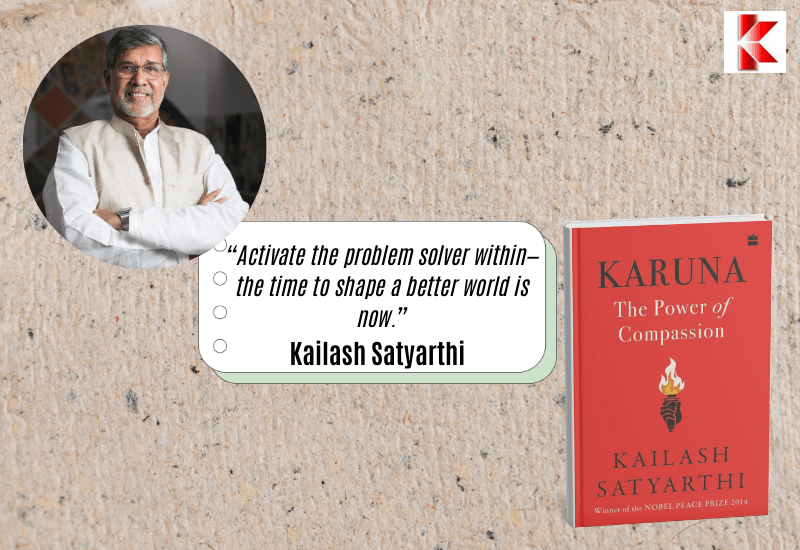
Kailash Satyarthi: Activate the problem solver within—the time to shape a better world is now.