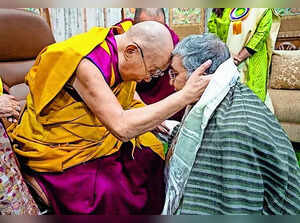
Tibetans in exile commemorate 86th anniversary of Dalai Lama’s enthronement
Kullu: Tibetans in exile on Sunday commemorated the 86th anniversary of the enthronement of the 14th Dalai Lama at an event held in the Tsuglagkhang, the main Tibetan temple complex in Mcleodganj, Dharamshala, even as the Tibetan Parliament in exile issued a statement saying it prays for the day the “issue of Tibet is resolved and the Tibetans are reunited with each other”.
Those who attended the event included Nobel laureate Kailash Satyarthi, Philippine Members of Parliament Rufus Rodriguez and Adrian Amatong, former Kalon Tripa (the head of the govt), Prof Samdhong Rinpoche, Kyabje Kundeling Rinpoche, the leadership of the Central Tibetan Administration (CTA) including Sikyong Penpa Tsering and Speaker Sonam Tenphel, religious leaders from various faiths, and Tibetan community members.
Born Lhamo Dhondup, in Taktser in the Domey province of Tibet on July 6, 1935, he was enthroned as the 14th Dalai Lama at the age of 4 on February 22, 1940. The ceremony commenced in the morning with the offering of Mendrel Tensum — a symbolic auspicious offering representing the body, speech, and mind of the Buddha — presented by the Speaker of the Tibetan Parliament in Exile and the Sikyong of the Central Tibetan Administration.
Members of the Tibetan Institute of Performing Arts led the rendition of the Tibetan National Anthem as the Sikyong hoisted the Tibetan national flag, and Kailash Satyarthi hoisted the Indian national flag.
During the ceremony, Sikyong Penpa Tsering delivered the Kashag’s (the executive branch of the CTA) statement for the occasion. Tsering said that the reincarnation of the 14th Dalai Lama was recognised with unmistakable certainty and without any external interference.
However, Tsering added that the communist govt of the People’s Republic of China (PRC) persistently propagated the falsehood that the representative of the Chinese Kuomintang at that time presided over the ceremony and that Regent Reting Rinpoche submitted a petition requesting exemption from the so-called “Golden Urn Lottery”, a method introduced by China to select the Dalai Lama but not followed by the Tibetans.
“Innumerable archived documents and successive scholarly works not only debunked these false claims but also brought the actual facts to light,” said Tsering. Former Kalon Tripa Prof Samdhong Rinpoche, in his address in Hindi, reflected on the historical significance of the Dalai Lama’s enthronement and his enduring contributions to peace, compassion, and the Tibetan cause. He stated that the enthronement marked a historic turning point not only for Tibet but also for the wider world, adding that despite immense challenges, His Holiness’s compassionate leadership enabled Tibetans to preserve their cultural and religious identity and share it globally.
Guest of Honour Adrian Amatong, Member of the House of Representatives of the Philippines, paid tribute to the Dalai Lama on the anniversary of his enthronement, describing it as the beginning of a lifetime devoted to compassion, peace, and the dignity of the Tibetan people.
Drawing parallels with the Philippines’ own historical experiences, he emphasised that the strength of a people lies in the resilience of their spirit, culture, and hope for the future, and expressed solidarity with the Tibetan people.
In his address, Guest of Honour Rufus Rodriguez said the Dalai Lama was awarded the Nobel Peace Prize in 1989 in recognition of his unwavering commitment to non-violence and compassion.
As a representative of the Philippines, he also expressed pride that his country conferred upon His Holiness the prestigious Ramon Magsaysay Award for Community Leadership in 1959, an honour that remains widely respected among the Filipino people.
He described the Dalai Lama as “a beacon of light for freedom and compassion in the world”.
In his address, Chief Guest Kailash Satyarthi described the 86th anniversary as “a journey of 86 years that cut through darkness and moved towards light”, noting that His Holiness continued to carry that light for humanity since his enthronement.
Reflecting on the early life of the Dalai Lama, he observed that a child from an ordinary family was placed on the Golden Throne at the age of 4, but stressed that the greatness associated with that seat came from the person, not the position.
Kailash Satyarthi further said that “no govt or political authority, regardless of power or wealth, possesses the moral legitimacy to appoint a Dalai Lama in place of His Holiness now or in the future”.
Describing the institution as a unique spiritual tradition, he stated that the recognition of the next Dalai Lama rests solely within the established religious process and the guidance of His Holiness. “Even if he lives to 110 years, the next Dalai Lama will be the one chosen according to this tradition — no one else can decide that,” he said.
Following this, Speaker Khenpo Sonam Tenphel delivered the Tibetan Parliament in Exile statement for the occasion.
Tenphel said that the Tibetan Parliament in Exile offers earnest prayers for an auspicious turn of events in which “the issue of Tibet is resolved, Tibetans in Tibet and in exile are reunited and the Dalai Lama returns to Tibet and once again is seated on the high golden throne in the Potala Palace in the capital, Lhasa.” MSID:: 128678603 413 |